
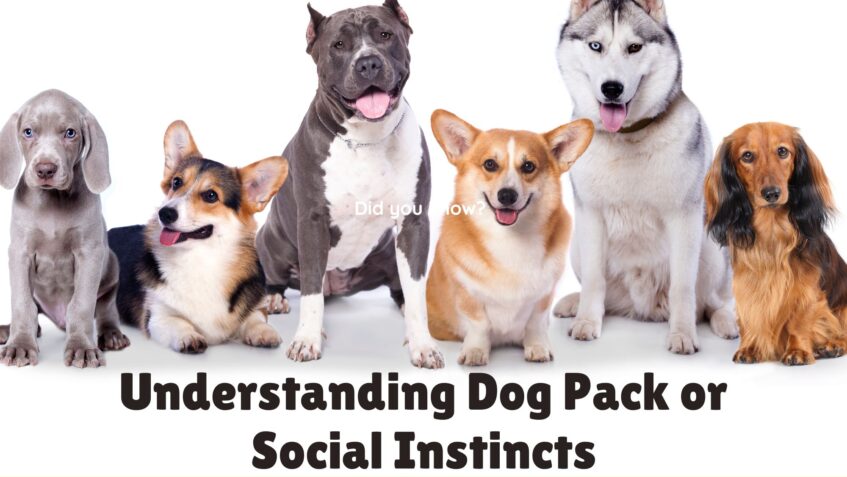
Unleashing the Pack Instinct: Understanding Your Dog’s Social Nature
Dog’s behavior is well adapted to the need of humans. As a pet they have become our friends and companions, and as a working animal they can be trained to do a wide range of useful tasks.
Dogs have adapted to living with humans and may form strong bonds with their human families, viewing them as their “pack.” Understanding and respecting these natural instincts can contribute to a positive and enriching relationship between humans and dogs.
Here are key aspects of dog pack instinct:
Dog pack instinct refers to the natural and instinctive behaviors exhibited by dogs that are derived from their ancestry as pack animals. Dogs are descendants of wolves, which are highly social animals that live in family groups known as packs. Even though domestic dogs have been living with humans for thousands of years, many of their behaviors are rooted in their pack instincts.
- Social Hierarchy: In a pack, there is a clear social structure with dominant and subordinate members. Dogs often display this hierarchical structure within a household or a group of dogs. They may establish a pecking order, where some dogs assume leadership roles while others take more submissive positions.
- Communication: Dogs use body language, vocalizations, and scent marking to communicate within a pack. This communication is essential for maintaining order, signaling submission or dominance, and coordinating group activities. Even in a domestic setting, dogs rely on these forms of communication to interact with other dogs and with humans.
- Cooperation and Group Activities: Pack animals, including dogs, are naturally cooperative. In a pack, members work together for activities such as hunting, guarding, and caring for offspring. Domestic dogs may exhibit cooperation when engaged in play, exploration, or other shared activities with their human or canine companions.
- Security in Numbers: Pack animals find safety and security in numbers. Dogs may feel more comfortable and secure when they are part of a group, whether that group consists of other dogs or their human family. This instinct may contribute to behaviors such as seeking closeness or comfort from their “pack.”
- Territorial Behavior: Packs often establish and defend territories. In a domestic setting, a dog may perceive their home and surrounding area as their territory. This can lead to behaviors like marking, patrolling, or guarding.
It’s important to note that while pack instincts play a role in canine behavior, individual dogs can have varied temperaments and may not strictly adhere to pack dynamics.
You may also visit – https://www.facebook.com/angkopparasahayop


