
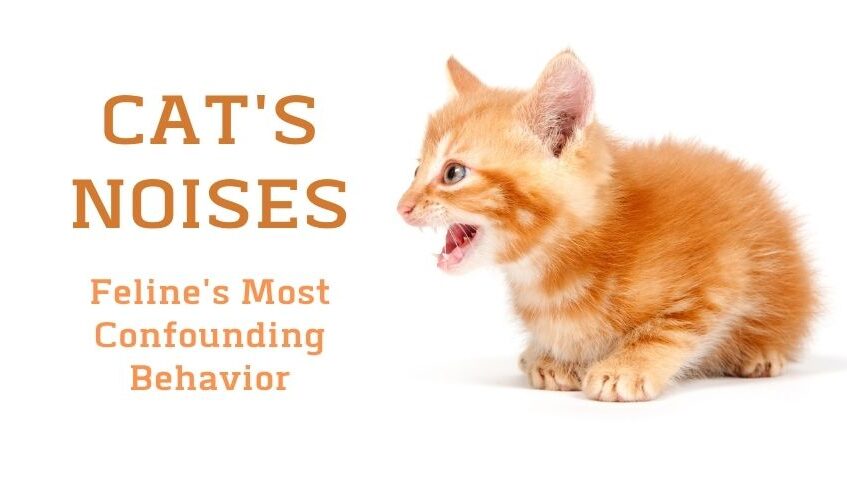
Feline’s Most Confounding Behavior: Cat’s Noises
Feline’s Most Confounding Behavior: Cat’s Noises
All cats make sounds—from meows and purrs to growls and hisses—but some felines are more vocal than others. Domestic cats make more sounds than other carnivores. 1 Cat emits sounds as a form of greeting and to seek attention. They also vocalize to express happiness, appreciation, fear, pain, and aggression
There are about 100 different cat noises, which our feline friends mix and match to talk to us. Let’s review some of the most common cat noises here:
Vocalization
Cats vocalize in many ways depending on their breed, their mood, and whom they are talking to.
Purr
The purr is a continuous, soft, vibrating sound made in the throat by most cat species. Domestic kittens can purr as early as two days of age. Purring is often believed to indicate a positive emotional state, but cats sometimes purr when they are ill, tense, experiencing painful moments, or dying. Did you know that a cat’s purr is also believed to have healing benefits for humans?
Meow
A “Meow” or “Miaow” sound is the most familiar vocalization of adult cats. It can be assertive, plaintive, friendly, bold, welcoming, attention-soliciting, demanding, or complaining. Adult cats do not meow to communicate with other cats. They only meow when speaking to their human guardians.
Chirr
The chirr or chirrup sounds like a meow rolled on the tongue. It is commonly used by mother cats to call their kittens inside the nest. Kittens recognize their own mother’s chirp and do not respond to the chirps of other mothers. It is also used by friendly cats, welcoming the approach of another cat or a human. Humans can mimic the sound to reassure and greet pet cats.
Chirping and Chattering
Cats sometimes make excited chirping or chattering noises when observing or stalking prey. Cats often chirp when birds or squirrels watch. Sometimes they chirp to get their guardian’s attention. These range from quiet clicking sounds, to loud but sustained chirping mixed with the occasional meow.
Trilling
Cats trill when they are happy to see someone; human and cat friends.
Humming
Some cats make a humming sound when they are anxious, to get their guardian’s attention, when they are hungry, or when they want to play.
Call
The call is a loud, rhythmic voice made with the mouth closed. It is primarily associated with female cats soliciting males, and sometimes when males fight with each other.
Growl, Snarl, Hiss, and Spitt
The growl, snarl, and hiss are all associated with either offensive or defensive aggression. They are usually accompanied by a postural display intended to have a visual effect on the perceived threat. Cats hiss when they are startled, scared, angry, or in pain, and also to scare off intruders into their territory. If the hiss and growl warning does not remove the threat, an attack may follow. “Spitting” is a shorter but louder and more emphatic version of hissing.
By knowing what your cat is trying to say, you’ll be better able to predict her mood, intentions, and needs. Whether she is hungry, sick, happy, lonely, playful, or mad, you’ll understand and be better equipped to give her what she needs. And the two of you will be able to have a nice, friendly cat chat.


