Blog

04 Jul
0

CAT’S SENSES

CAT’S SENSES

The sensory organs of cats allow them to hunt, jump and climb, enabling cats to survive. Knowing how to protect your cat’s sensory organs will help keep your cat healthy and happy.


SENSE OF SIGHT
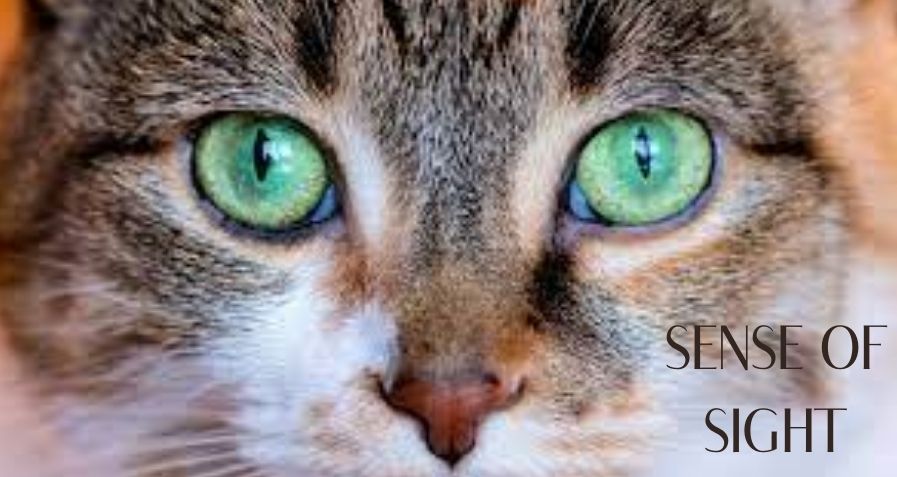
Cats are generally nocturnal in habit.

The retina of the cat’s eye is made extra sensitive to light by a layer of guanine, which causes the eye to shine at night in a strong light. The eyes themselves, large with pupils that expand or contract to mere slits according to the density of light, do not distinguish colors clearly.

Cats have a third eyelid, or nictitating membrane commonly called the haw. Its appearance is used frequently as an indicator of the cat’s general state of health.

A cat’s visual acuity is anywhere from 20/100 to 20/200, which means a cat has to be at 6 meters to see what an average human can see at 20 or 30 meters. Cats seem to be nearsighted, which means they cannot see far objects as well. The ability to see close objects would be well-suited for hunting and capturing prey.


SENSE OF SMELL
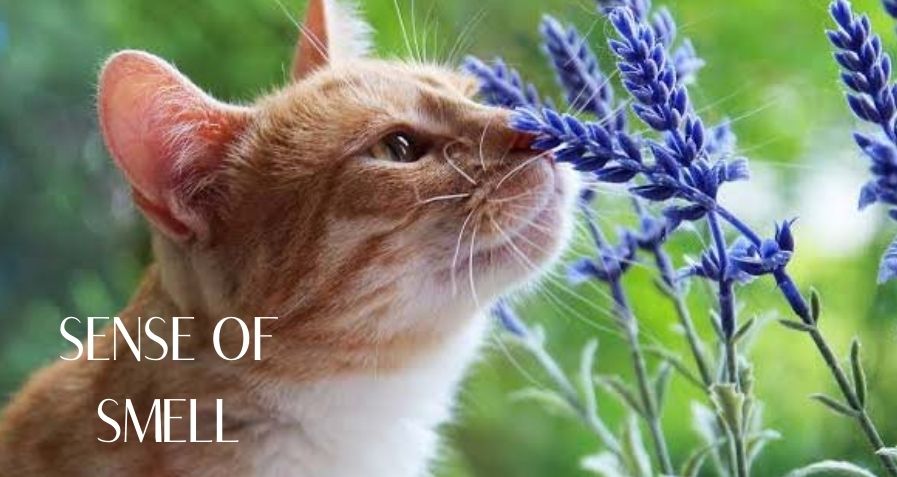
The cat’s sense of smell, particularly well developed in the adult, is crucial to its valuation of food, so that a cat whose nasal passages become clogged as a result of illness may appear to lose its appetite completely. Cats can distinguish the odor of nitrogenous substances (e.g., fish) especially keenly.


SENSE OF TOUCH
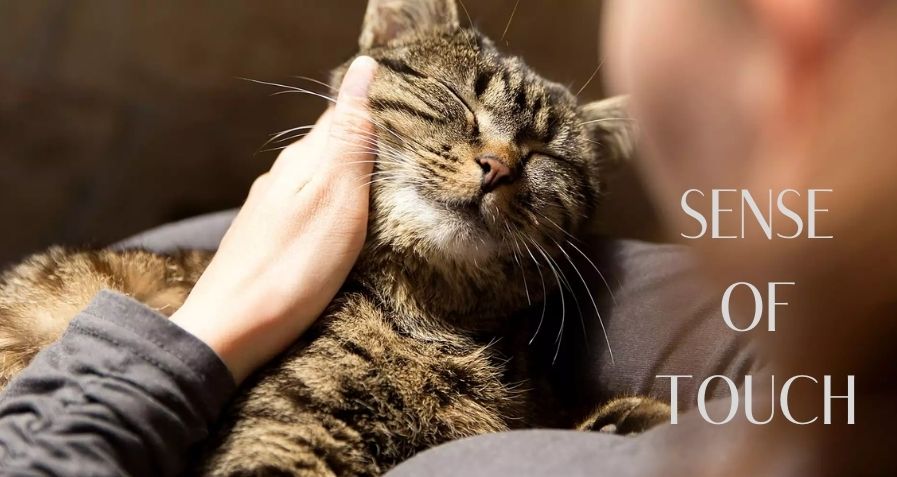
The sense of touch is acute in cats. The eyebrows, whiskers, hairs of the cheek, and fine tufts of hair on the ears are all extremely sensitive to vibratory stimulation. The functions of the whiskers (vibrissae) are only partially understood; however, it is known that, if they are cut off, the cat is temporarily incapacitated. The toes and paws, as well as the tip of the nose, are also very sensitive to touch.


SENSE OF HEARING
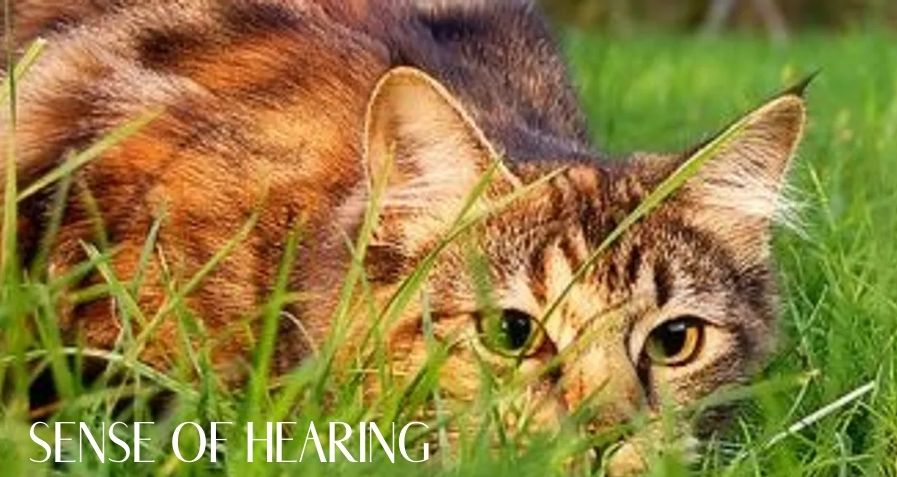
Cats also have an acute sense of hearing. Their ears contain almost 30 muscles (compared with 6 in humans); as a result, they can turn them many times more quickly in the direction of a sound than can a dog. The ears of cats are receptive to ultrasonic frequencies up to 85,000 vibrations per second, greatly exceeding the hearing capabilities of dogs, which register 35,000 vibrations per second.


SENSE OF TASTE
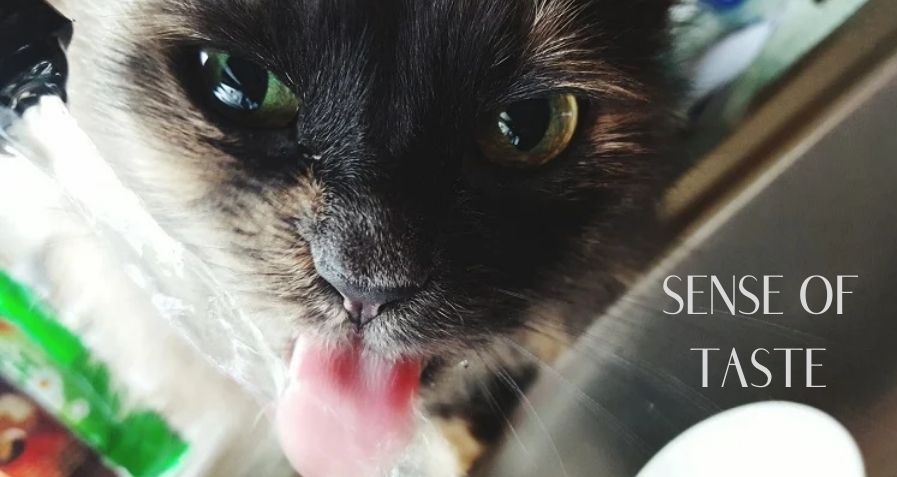
The tongue of all cats, which has a patch of sharp, backward-directed spines called filiform papillae near the tip, has the appearance and feel of a coarse file; the spines help the cat to groom itself. The disposition to cleanliness is well established in cats, and they groom themselves at length, especially after meals.

Despite having fewer taste buds than other animals, cats seem to be able to taste sour, bitter, salty, and umami flavors well enough. This is likely due, in part, to the cat’s highly acute sense of smell.


You may also visit – https://www.facebook.com/angkopparasahayop


Read More
04 Jul
0

Domestic Cat

Domestic Cat

Domestic cats, no matter their breed, are all members of one species.


COMMON NAME: Domestic Cat

SCIENTIFIC NAME: Felis catus

TYPE: Mammals

DIET: Carnivore

SIZE: 28 inches

WEIGHT: 5 to 20 pounds

SIZE RELATIVE TO A 6-FT MAN


Cat (Felis catus), also called house cat or domestic cat, is a member of the family Felidae in the order Carnivora. It is also the smallest member of that family, which includes lions, tigers, and pumas.


Felis catus has had a very long relationship with humans. Ancient Egyptians may have first domesticated cats as early as 4,000 years ago. Plentiful rodents probably drew wild felines to human communities. The cats’ skill in killing them may have first earned the affectionate attention of humans. Early Egyptians worshipped a cat goddess and even mummified their beloved pets for their journey to the next world—accompanied by mummified mice! Cultures around the world later adopted cats as their own companions.

The retina of the cat’s eye is made extra sensitive to light by a layer of guanine, which causes the eye to shine at night in a strong light. Cats’ eyes are large with pupils that expand or contract to mere slits according to the density of light.

Domestic cats and other species of the genus Felis purr. Purring is a continuous, rattling hum and often is interpreted as an expression of pleasure or contentment. However, purring also occurs in cats that are injured and in pain.


Hunting Abilities

Like their wild relatives, domestic cats are natural hunters able to stalk prey and pounce with sharp claws and teeth. They are particularly effective at night when their light-reflecting eyes allow them to see better than much of their prey. Cats also enjoy acute hearing. All cats are nimble and agile, and their long tails aid their outstanding balance.


Communication

Cats communicate by marking trees, fence posts, or furniture with their claws or their waste. These scent posts are meant to inform others of a cat’s home range. House cats employ a vocal repertoire that extends from a purr to a screech.


Diet

Domestic cats remain largely carnivorous and have evolved a simple gut appropriate for raw meat. They also retain the rough tongue that can help them clean every last morsel from an animal bone (and groom themselves). Their diets vary with the whims of humans, however, and can be supplemented by the cat’s own hunting successes.


Cats as pets

The popularity of the cat, especially of pedigreed breeds, has continued to grow. The cat’s independent personality, grace, cleanliness, and subtle displays of affection have wide appeal. Typically, cats are creatures of habit; they are inquisitive, but not adventurous, and are easily upset by sudden changes in routine. The ideal household cat has been separated from its mother between the ages of two and four months, raised in a clean home, kept away from unhealthy animals, and inoculated against common infectious cat diseases. Although cats often enjoy the company of other cats, especially when raised together from kittenhood, introducing a strange cat to other cats in the home can cause stress, aggression, and other behavior problems. Cats are generally less sociable than dogs, who more readily accept a new pack member.


You may also visit – https://www.facebook.com/angkopparasahayop
Read More
26 Jun
0

CAN YOU LIVE WITH A CAT IF YOU ARE ALLERGIC?

CAN YOU LIVE WITH A CAT IF YOU ARE ALLERGIC?


People with cat allergies aren’t allergic to fur, but rather a protein found in a cat’s saliva, urine, and dander.


Cat allergies are twice as common as dog allergies. But contrary to what you might think, it’s not the fur or hair that’s the real problem. People with cat allergies are really allergic to proteins in the cat’s saliva, urine, and dander (dried flakes of skin).


How do these tiny proteins cause such a big allergic reaction in the body?


People with allergies have oversensitive immune systems. Their bodies mistake harmless things – like cat dander – for dangerous invaders, and attack them as they would bacteria or viruses. The symptoms of the allergy are the side effects of your body’s assault on the allergen, or trigger.


Keep in mind that even if you don’t have an actual cat allergy, your cat can still indirectly cause your allergies to flare up. Outside cats can bring in pollen, mold, and other allergens on their fur.


And what about so-called “hypoallergenic” cats?


So regardless of its breed, hair length, or how much it sheds. If you know that you or another family member is allergic to cats, getting one, no matter what the breed is not a good idea.


What Are the Symptoms of Cat Allergies?

Symptoms of cat allergies can include:

  • coughing and wheezing
  • hives or a rash on the chest and face
  • red, itchy eyes
  • redness of the skin where a cat has scratched, bitten or licked you
  • runny, itchy, stuffy nose
  • sneezing


Fast facts about cat allergies:

  • Most people experience mild to moderate symptoms.
  • Some people who have allergies may be able to live with cats.
  • Researchers do not fully understand why some people develop cat allergies and others do not.


Can you live with a cat if you are allergic?


Depending on the severity of the allergy, it may be possible to live with cats. Doing so requires a combination of allergy treatment and diligent management of cat hair and other particles. Knowing what specific proteins cause the allergic reaction can help people with cat allergies decide how best to manage their symptoms.


An allergy does not have to cause chronic suffering, so take proactive measures to reduce the likelihood of an allergic reaction.

Read More
26 Jun
0

WHY DO CATS SLEEP SO MUCH?

WHY DO CATS SLEEP SO MUCH?


More than half of cats sleep between 12 and 18 hours a day1, and nearly 40% of cats sleep more than 18 hours per day. As they grow older, a majority of cats sleep for more hours each day than they did in their younger years.


How long do cats sleep?

Cats sleep on average 15 hours a day, with some sleepy kitties getting in up to 20 hours of shut-eye each day.


The first thing you should realize is that cats are most active between dusk and dawn, which means that they sleep mostly during the day and become active around twilight. As soon your cat is done with breakfast, as the rest of the world winds up for action, you’ll find him winding down for a long day of slumber.


Why do cats sleep so much?

Cats sleep long hours in order to recharge for their next hunting spree.

Cats have the physiology of a predator, meaning that they’re hardwired to give chase and hunt.  Although they have been domesticated, for the most part, housecats still retain that wild streak.

Even cats at play will display the feline primal instincts of creeping about in the shadows and, without a whisper of warning, pouncing on their target prey.


What is a catnap?


Curled up, stretched out or standing up, cats have no problem dozing off whenever they feel like it. We humans have taken notice and used it as an inspiration for our quick naps during the day. The term ‘catnap’ was coined to refer to a short sleep similar to the ones cat have.


One Eye Open


Like people, cats either doze in a light sleep or sleep very deeply. When your cat dozes (which lasts about fifteen minutes to a half-hour), he will position his body so that he can spring up and into action at a moment’s notice.


During deep sleep, cats experience rapid (or quick) brain movement. Deep sleep tends to last about five minutes, after which the cat goes back to dozing. This dozing-deep sleep pattern goes on until the cat wakes up.


Felines are affected by the weather


Just like us, cat behavior can vary greatly depending on their breed, age, temperament and overall health. But, whatever your kitty’s usual disposition, it has been observed that cats sleep more when the weather calls for it. Yes, even if your kitty is an exclusive indoor-dweller, a rainy or cold day will have him (and probably you) yawning and looking for some shut-eye.


Why do cats sleep on you?


You’ve probably woken up more than once to your cat curled up fast asleep on your chest. If you’re wondering why does my cat sleep on me when they have a perfectly comfy bed of their own, here are a few possible reasons:


  • They trust you.
  • They want to keep warm.
  • They think you’re a comfortable spot.
  • They feel the safest when you’re around.
  • They love you.


In most cases, pet cats sleeping for a large part of the day will be normal, however, if you have any concerns or have noticed a difference in your cat’s behavior that concerns you talk to your vet.

You may also visit – https://www.facebook.com/angkopparasahayop

Read More
26 Jun
0

THE DANGERS OF DOG CHAINING

THE DANGERS OF DOG CHAINING


Dog chaining simply means that a person ties a dog with a rope, line, or chain to a stationary object.


What is wrong with chaining dogs?


Chaining a dog goes against its natural instincts – dogs were not meant to be tied up. Most become protective of the area around them and in some cases, downright mean, even to their owners. They feel confined and trapped and it drives them crazy.


Persistently chained dogs also lack proper exercise – they are frequently denied access to basic shelter, shade, food, and/or water. They are left vulnerable to attacks by other animals, people, and vermin. Finally, they are forced to eat, sleep, urinate, and defecate in the same limited space.


Chaining Dogs Makes Them Territorial and Aggressive – their small square of backyard suddenly becomes theirs to defend, so when people approach them, they act out with aggressive, territorial behaviors like barking and even snapping or biting.


Leaving your dog tied up is dangerous – she could also become entangled in her leash, and injure herself. Passersby could taunt or tease her, or even release her and harm her. She could suffer from the heat or the cold, or the elements, and become ill.


When kept continuously chained, dogs become neurotic, unhappy, anxious, and often aggressive – dogs are genetically determined to live in a group. A dog kept chained alone in one spot for hours, days, months, or even years suffers immense psychological damage.


The practice also creates secondary hazards that have killed or injured many dogs.


How You Can Combat Dog Chaining

  •  If you own a dog, make your dog welcome in your home and take him or her for leashed walks and outdoor play in a fenced area.
  • Commit to providing obedience training to each dog in your household.
  • Offer to walk a chained dog in your community, and check to ensure the dog always has fresh water and adequate food.
  • Call your local animal control office OR animal welfare group any time you suspect an animal’s basic needs are not being met.
  • Be supported and guided by Animal Welfare Act (RA 8485) and the Responsible Ownership Act (RA 9482).

You may also visit – https://www.facebook.com/angkopparasahayop

Read More
21 Jun
0

Nail (Claw) and Nailbed (Clawfold) Disorders

Nail (Claw) and Nailbed (Clawfold) Disorders


Dogs and cats with claw diseases are presented infrequently in small animal practice. However, inflammation and/or infection of claws frequently are very painful due to the anatomical features of this structure (the dermis and noncornified epidermis are situated between the stratum corneum comprising the hard claw horn and the bony third phalanx and no subcutis is present). Thus, claw disease may be a cause of great distress to patient and owner alike. 

Nails and ungual folds—subject to trauma, infection, vascular insufficiency, immune-mediated disease, neoplasia, defects in keratinization, and congenital abnormalities.

Ungual fold—crescent-shaped tissue that surrounds the proximal nail

Coronary band and dorsal ridge—produces most of the nail

Paronychia—inflammation of soft tissue around the nail

Onychomycosis—fungal infection of the nail

Onychorrhexis—brittle nails that tend to split or break

Onychomadesis—sloughing of the nail

Nail dystrophy—deformity caused by abnormal growth; often a sequela of a disorder

Onychomalacia—softening of the nails


SIGNALMENT

  • Dog and cat
  • Mean age range—SLO 3–8 years
  • No predominant sex reported


SIGNS

  • Licking at the feet and/or ungual folds
  • Lameness
  • Pain
  • Swelling, erythema, and exudate of ungual fold
  • Deformity or sloughing of nail
  • Discoloration of the nail
  • Hemorrhage from the nail or at loss of a nail
  • Previous description of being “tender-footed”


CAUSES

Paronychia

  • Infection—bacteria, dermatophyte, yeast (Candida, Malassezia), leishmaniasis
  • Demodicosis
  • Immune-mediated—pemphigus, bullous pemphigoid, SLE, drug eruption, SLO
  • Neoplasia—subungual squamous cell carcinoma, melanoma, eccrine carcinoma, osteosarcoma, subungual keratoacanthoma, inverted squamous papilloma
  • Arteriovenous fistula


Onychomycosis

  • Dogs—Trichophyton mentagrophytes—usually generalized
  • Cats—Microsporum canis


Onychorrhexis

  • Idiopathic—especially in dachshunds; multiple nails
  • Trauma
  • Infection—dermatophytosis, leishmaniasis


Onychomadesis

  • Trauma
  • Infection
  • Immune-mediated—pemphigus, bullous pemphigoid, SLE, drug eruption, SLO
  • Vascular insufficiency—vasculitis, cold agglutinin disease
  • Neoplasia—see above
  • Idiopathic


Nail Dystrophy

  • Acromegaly
  • Feline hyperthyroidism
  • Zinc-responsive dermatosis
  • Congenital malformations


DIAGNOSIS

DIFFERENTIAL DIAGNOSIS

  • Trauma or neoplasia often affects a single nail.
  • Involvement of multiple nails suggests a systemic disease.
  • Immune-mediated diseases (except SLO) usually have other skin lesions in addition to nail or ungual fold lesions.


CBC/BIOCHEMISTRY/URINALYSIS

May show evidence of SLE, diabetes mellitus, hyperthyroidism, or other systemic illness.


OTHER LABORATORY TESTS

  • FeLV
  • Serum thyroxine
  • ANA titer
  • IMAGING
  • Radiographs—osteomyelitis of third phalanx, neoplastic change


OTHER DIAGNOSTIC PROCEDURES

  • Biopsy—often involves a third phalanx amputation; inclusion of the coronary band required for diagnosis of most diseases
  • Cytology of exudate from the nail and/or fold
  • Skin scraping
  • Bacterial and fungal culture


TREATMENT

PARONYCHIA

  • Surgical removal of nail plate (shell)
  • Antimicrobial soaks
  • Identify underlying condition and treat specifically.


ONYCHOMYCOSIS

  • Antifungal soaks—chlorhexidine, povidone iodine, lime sulfur
  • Surgical removal of nail plate—may improve response to systemic medication
  • Amputation of third phalanx


ONYCHORRHEXIS

  • Repair with fingernail glue (type used to attach false nails in humans).
  • Remove splintered pieces and maintain with rotary sander (Dremel).
  • Treat underlying cause.
  • Amputate third phalanx, last resort.


ONYCHOMADESIS

  • Antimicrobial soaks
  • Treat underlying cause


NEOPLASIA

  • Determined by biologic behavior of specific tumor
  • Surgical excision
  • Amputation of digit or leg
  • Chemotherapy and/or radiation therapy

NAIL DYSTROPHY

  • Treat underlying cause


MEDICATIONS

DRUG(S) OF CHOICE

  • Bacterial paronychia—systemic antibiotics based on culture and sensitivity.
  • Yeast paronychia—Candida or Malassezia paronychia—ketoconazole (5–10 mg/kg PO q12–24h); topical nystatin or miconazole.
  • Onychomycosis—griseofulvin (50–150 mg/kg PO/day) or ketoconazole (5–l0 mg/kg PO q12h) for 6–12 months until negative cultures; itraconazole (10 mg/kg PO q24h) for 3 weeks and then pulse therapy until resolved.
  • Onychomadesis—determined by cause; immunomodulation therapy for immune-mediated diseases; medications include cyclosporine, doxycycline with niacinamide, pentoxifylline, vitamin E, essential fatty acid supplementations, and chemotherapeutic agents (e.g., azathioprine, chlorambucil).


CONTRAINDICATIONS

Griseofulvin—do not use in pregnant animals.


PRECAUTIONS

  • Griseofulvin—may cause bone marrow suppression, anorexia, vomiting, and diarrhea; absorption enhanced if given with a high-fat meal.
  • Ketoconazole—may cause anorexia, gastric irritation, hepatic toxicity, and lightening of the hair coat.


FOLLOW-UP

EXPECTED COURSE AND PROGNOSIS

  • Bacterial or yeast paronychia and onychomycosis—treatment may be prolonged and response may be influenced by underlying factors.
  • Onychorrhexis—may require amputation of the third phalanx for resolution.
  • Onychomadesis—prognosis determined by underlying cause; immune-mediated diseases and vascular problems carry a more guarded prognosis than do trauma or infectious causes.
  • Neoplasia—excised by amputation of the digit; malignant tumors metastasize by the time of diagnosis.


Visit your veterinarian as early recognition, diagnosis, and treatment are essential.

You may also visit – https://www.facebook.com/angkopparasahayop

Read More
20 Jun
0

Do cats get cold?

Do cats get cold?

Cats can catch colds just like people, displaying similar symptoms such as sneezing and a runny nose. Here, our Bartlett vets talk about causes and when to seek veterinary care.


How did my cat catch a cold?

Sneezing and sniffles are signs that your cat has a cold, but you may be wondering how it happened in the first place. And, more importantly, how you can avoid it in the future.

Just like colds in humans, cat colds are contagious. This means that outdoor cats are more likely to find themselves with the cold virus than indoor cats because they are more likely to interact with other cats.


Cat colds are upper respiratory infections (URI) caused by bacteria or a virus. It is not contagious for humans but easily transmits among cats, especially in compact conditions.  So, if you’ve boarded your cat recently and they now have a cold, it’s likely your pet was near another cat suffering from a cold.


Cat Colds: Signs & Symptoms

  • sneezing
  • sniffles
  • watery eyes
  • runny nose
  • mild fever
  • reduced appetite
  • coughing


How to Care for Your Sick Cat

  • If your cat has a cold, you can help them feel less uncomfortable by wiping their runny nose with a clean cloth, and runny eyes with a cloth and saline solution. You can also run a humidifier so the air isn’t too dry.


  • If your cat seems to be stuffed up, making breathing a little difficult, secure them in their pet carrier, put a bowl of hot water in front of the cage, and cover both with a blanket for about 15 minutes.


  • It’s important for your cat to continue to eat and drink so they can get better quicker. Food that is warmed up and easier to swallow might make this process more appealing for them. They also need to stay warm, so place an extra blanket in their bed or favorite area to curl up.


Do not ever give human cold medication (or any medication without the advice of your vet) to your cat. Always speak with your vet to see what they recommend for your pet.


When to Seek Veterinary Care

  • In most cases, cat colds are harmless and will go away within 1-2 weeks. You do need to monitor their health, however, and if there is no sign of improvement by the fourth day, you should make an appointment with your vet as a persisting cold that does not get treated properly may develop into pneumonia.


  • As with humans, it’s important to be careful with older cats, kittens, and cats with other conditions that may make them more susceptible to the effects of a cold. This is especially true of cats that are nursing, or that haven’t been vaccinated. If your cat falls into one of these categories, make an appointment immediately.


In any case, if your cat begins coughing, has difficulty breathing, or stops eating, they need to see a vet as soon as possible.

You may also visit – https://www.facebook.com/angkopparasahayop

Read More
20 Jun
0

Cats Can’t Taste Sweetness

Cats Can’t Taste Sweetness

Cat owners may claim that their beloved pets love ice cream and doughnuts, but it’s the fat that cats enjoy. Felines’ taste receptors can’t detect sugar. Humans, like most other mammals, have five different receptors—salty, bitter, sour, umami (savory), and sweet. The taste receptor for sweet is encoded in two genes that code for two proteins, both of which are involved in our ability to enjoy sugary treats.

Cats lack the receptor for sweetness.  They only have 470 taste buds. Compare this to 1,700 in dogs, and 9,000 in humans. Of those limited taste receptors in feline mouths, none are programmed to taste sweetness.

Our feline friends are only interested in one thing: meat because they lack the ability to taste sweetness.  They do not possess the genetic “hardware” needed to taste sweets.

In cats, a chance mutation appears to have broken one of these genes, and this broken version persisted. That’s why tigers, lions, and your kitty will never have a sweet tooth. To her, the satiating tastes are the umami of meat and the saltiness of blood.

Cats lack an important taste receptor gene that enables the brain to recognize sweet tastes.

Taste receptors are proteins in the cells of the taste buds that enable the brain to recognize certain flavors. Researchers identified the DNA sequences and examined the structures of the 2 known genes Tas1r2 and Tas1r3 that encode the sweet taste receptor heteromer T1R2/T1R3 in other mammals. “It was determined that “cat Tas1r3 is an expressed and likely functional receptor, whereas cat Tas1r2 is an unexpressed pseudogene.”

What does this mean? Essentially, cats only seem to have one of the two known taste receptors that detect sweetness. In general, cats do not seem to be able to taste or enjoy sweet flavors. Having only one of the two sweet taste receptors may mean that cats can detect some sweetness at very high concentrations, but they are unable to fully experience it in the way humans and many other mammals do.

You may also visit – https://www.facebook.com/angkopparasahayop


Read More
20 Jun
0

𝗔𝗻𝗶𝗺𝗮𝗹 𝗟𝗶𝘃𝗲𝘀 𝗠𝗮𝘁𝘁𝗲𝗿 – 𝗣𝗿𝗲𝘃𝗲𝗻𝘁, 𝗣𝗿𝗲-𝗲𝗺𝗽𝘁 𝗛𝗶𝘁-𝗮𝗻𝗱-𝗥𝘂𝗻

𝗔𝗻𝗶𝗺𝗮𝗹 𝗟𝗶𝘃𝗲𝘀 𝗠𝗮𝘁𝘁𝗲𝗿 – 𝗣𝗿𝗲𝘃𝗲𝗻𝘁, 𝗣𝗿𝗲-𝗲𝗺𝗽𝘁 𝗛𝗶𝘁-𝗮𝗻𝗱-𝗥𝘂𝗻

 
Thousands of animals are injured or died on Philippine roads every day as drivers don’t brake for animals.
 
A cruel fact that a life was snuffed out in a second by a speeding car driver, with no thought, no respect for life, and no punishment. Other motorists even deliberately speed up or hit a crossing animal or helpless puppies, kittens, and already weak dogs and cats.
 
We shout – “𝑬𝒏𝒐𝒖𝒈𝒉 𝒐𝒇 𝒕𝒉𝒊𝒔 𝒄𝒓𝒖𝒆𝒍𝒕𝒚!”
What we need is a greater responsibility, to ensure that such drivers don’t speed but treat the pain and suffering they cause with appropriate respect and pay the penalty.
𝗟𝗲𝘁 𝘂𝘀 𝗮𝗹𝗹 𝗯𝗲 𝗿𝗲𝘀𝗽𝗼𝗻𝘀𝗶𝗯𝗹𝗲.
 
𝐑𝐞𝐦𝐞𝐦𝐛𝐞𝐫 𝐭𝐡𝐚𝐭 𝐥𝐢𝐭𝐭𝐥𝐞 𝐭𝐡𝐢𝐧𝐠𝐬 𝐦𝐚𝐭𝐭𝐞𝐫, 𝐭𝐡𝐞 𝐭𝐡𝐢𝐧𝐠𝐬 𝐰𝐞 𝐝𝐨 𝐟𝐨𝐫 𝐚𝐧𝐢𝐦𝐚𝐥 𝐰𝐞𝐥𝐟𝐚𝐫𝐞 𝐚𝐧𝐝 𝐩𝐫𝐨𝐭𝐞𝐜𝐭𝐢𝐨𝐧 𝐜𝐚𝐧 𝐠𝐨 𝐚 𝐥𝐨𝐧𝐠 𝐰𝐚𝐲 –
 
𝘽𝙚 𝙖 𝙍𝙀𝙎𝙋𝙊𝙉𝙎𝙄𝘽𝙇𝙀 𝙈𝙊𝙏𝙊𝙍𝙄𝙎𝙏!
Make sure to be extra vigilant and aware, especially during nighttime, and practice defensive driving in order to lower your chances of any probable accidents on the road.
 
Make sure to be extra vigilant and aware, especially during nighttime, and practice defensive driving in order to lower your chances of any probable accidents on the road.
𝙁𝙤𝙧 𝙥𝙚𝙩 𝙤𝙬𝙣𝙚𝙧𝙨 — remember that allowing your pet to roam freely without a leash, in public streets, or outside your home (even in your presence) is also a violation of RA9482 or The Anti Rabies Act. Protect them from being harmed or being harmful to others.
𝙄𝙛 𝙮𝙤𝙪 𝙖𝙧𝙚 𝙩𝙝𝙚 𝙙𝙧𝙞𝙫𝙚𝙧 – If you’re involved in an accident and an animal (whether in another vehicle or on the road) is injured you must stop, even if it wasn’t your fault.
 
Take full responsibility, and respond humanely while addressing potential insurance and legal implications.
 
𝗗𝗢 𝗡𝗢𝗧 𝗜𝗚𝗡𝗢𝗥𝗘 𝗼𝗿 𝗟𝗘𝗔𝗩𝗘 𝗧𝗛𝗘 𝗔𝗡𝗜𝗠𝗔𝗟 𝗪𝗜𝗧𝗛𝗢𝗨𝗧 𝗣𝗥𝗢𝗣𝗘𝗥 𝗖𝗔𝗥𝗘 𝗔𝗡𝗗 𝗧𝗥𝗘𝗔𝗧𝗠𝗘𝗡𝗧 – if the animal can be moved and handled SAFELY, bring the animal to the nearest vet or at least try and move the animal to a safe area, away from further injury.
 
You can also call the local government or the MMDA to assist, or seek help from the Barangay or from an animal welfare group.
 
#WeShareBecauseWeCare
#Angkop
#AngAnimalKoProtektado
#AngkopParaSaHayop
#AngkopMission
#AngkopVolunteer
#AngkopAnimalRescue

Read More
12 Jun
0

WHY DO CATS BATHE THEMSELVES?

WHY DO CATS BATHE THEMSELVES?


Why do cats clean themselves?  You must have seen a cat licking its paws or chewing on herself from time to time.

Cats are clean pretty much 100 percent of the time. That means you never have to take the time out of your day to perform the somewhat painstaking task of washing and grooming your cat.


Self-grooming is a trademark characteristic of most cats that begins right after birth. others lick their kittens to clean them, provoke urination and suckling, provide comfort, and strengthen their bond. At 4 weeks of age, kittens begin grooming themselves and shortly thereafter start grooming their mother and littermates. This self-grooming and mutual grooming (referred to as allogrooming) continue into adulthood.

A normal cat can spend as much as 50% of its waking time grooming itself (or another cat). As a result, cats are typically very clean animals, though in some cases grooming can become a form of obsession.


Why do cats groom?

Cats groom themselves not only to keep clean but for several other health reasons:

  1. To regulate body temperature.
  2. To keep her coat clean and smooth by distributing natural skin oils.
  3. To stimulate circulation.
  4. To cool herself down through evaporation of saliva.
  5. To eliminate parasites, infections, and allergies
  6. To prevent hairballs.
  7. Displacement behavior. If a cat feels embarrassed, anxious, or as though she’s in a conflict, she may lick to calm herself.


Should You Groom Your Cat?

If your cat enjoys being brushed or combed then I encourage you to do so. Grooming your cat can serve to strengthen the bond between you and your pet. Grooming can also help you screen your cat for any problems that may be developing on the skin. However, many cats do not take fondly to being groomed by any tools but their own, so if you value your own safety, it’s best to leave these cats to take care of the job themselves! If your cat is prone to hairballs, matting fur, or excessive shedding, you may need to leave the grooming to a professional groomer.

You may also visit – https://www.facebook.com/angkopparasahayop

Read More